Chemical Warfare: How Corporate Interests Shape Our Food, Health, and Environment
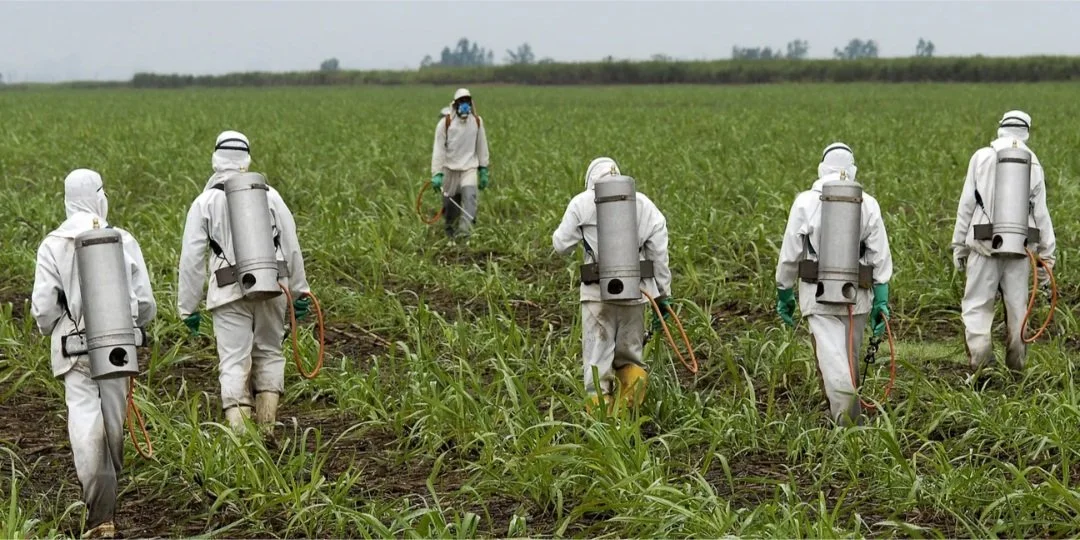
Glyphosate is one of the most widely used herbicides in the world, but to truly understand its impact, we must trace its roots back to the company that introduced it: Monsanto. Once a pioneer in agricultural chemicals, Monsanto's controversial legacy continues to influence global debates about health, science, and corporate power, especially after its $63 billion acquisition by Bayer in 2018.
Monsanto Chemical Works was founded in 1901 by John Queeny, who set out to create a company that could rival European chemical giants like Bayer, which dominated the global chemical market at the time. Queeny's vision was to liberate the American market from the grip of these foreign companies. The outbreak of WWI provided a unique opportunity for Monsanto when American chemical supplies were cut off from overseas, the company experienced rapid growth.
Meanwhile, in Atlanta, Coca-Cola was beginning to experiment with saccharin as a cheaper alternative to sugar, and Monsanto, which was producing saccharin at the time, became their supplier. Monsanto also began producing caffeine from discarded tea leaves, which they sold to Coca-Cola as well. So crucial was Coca-Cola to Monsanto's success that the company relied on payments to come in from the beverage giant before it could pay its own workers.
Over the course of its history, Monsanto gradually diversified its operations, often relying on coal tar, a byproduct of turning coal into coke, as a source for creating a variety of chemical products. This black, syrupy impurity contains carbon-based compounds, which could be transformed into everything from dyes to pharmaceuticals. By the 1920s, Monsanto turned its attention to oil refining, tapping into the waste products left behind after refining gasoline and other fuels. This waste, rich in compounds like polychlorinated bisphenols (PCBs), would become the foundation for numerous products, including an insulating material that would be used in almost every industry starting in the 1920s.
In the 1940s, Monsanto began producing DDT (dichlorodiphenyltrichloroethane), which was colorless, tasteless, and almost odorless. It was a chemical initially hailed as a miracle for combating malaria, typhus, and other insect-borne diseases. However, its widespread use and devastating environmental and health effects eventually led to its ban in most countries. Another dark chapter in Monsanto's history was its role as the largest producer of Agent Orange, a chemical weapon used during the Vietnam War, which had horrific long-term consequences for both the environment and those exposed.
It’s worth noting that while John Queeny, Monsanto’s founder, had no background in chemistry, he frequently hired European experts, particularly from Switzerland, to help develop and produce these chemicals, steering the company into new and often controversial industries
In the Monsanto chemical industry archives there is a confidential internal document that Monsanto executives were writing as they were debating what to do about PCBs in the 1960s. By then, it had become clear that PCBs were extremely toxic, and they had made their way into nearly every corner of daily life—from receipt paper to paint lining swimming pools, from food storage silos, to the cardboard used in children’s cereal boxes, and even in electrical equipment. At this time in the 1960’s Monsanto was the only company producing PCBs in the United States, making it both a major liability and an incredibly profitable venture, as the company faced little competition.
This internal document from this period, kept confidential for years, reveals the intense debate among Monsanto executives. One member noted that the issue was "snowballing," while another asked, "Where do we go from here?" One option, as a committee member suggested, was to "sell the hell out of them as long as we can,” capitalizing on the lack of competition and the profitability of the product. Another option was to stop making them immediately due to the extreme harm that they cause. But the committee instead recommended "The Responsible Approach" -- phasing out its PCB products, but only once it could develop alternatives.
The committee's "Responsible Approach" was not merely about phasing out PCBs, but about managing Monsanto's exposure to liability while maximizing profits. Their strategy was to maintain "one of Monsanto’s most profitable franchises" for as long as possible, but with a careful eye on reducing their exposure in terms of legal responsibility. To this end, executives went as far as drawing up graphs that charted profits versus liability over time. The goal was clear: continue reaping the financial benefits of PCBs while mitigating the growing risks associated with their use. At the same time, the company pushed for further studies, hoping to bolster their case against increasing governmental pressure and the mounting evidence linking PCBs to harmful environmental and health impacts.
But the company's own tests on rats, chickens and even dogs showed that "the PCBs are exhibiting a greater degree of toxicity than we had anticipated," which was reported by the committee chairman. Fish tests were worse: "Doses which were believed to be OK produced 100% kill."
The pressure on Monsanto’s consultants to produce favorable results intensified as the company’s leadership sought to downplay the growing concerns about PCBs. When the consultants expressed concerns, their response was blunt: "We are very sorry that we can't paint a brighter picture at the present time. Company studies found "ominous" concentrations of PCBs in streams and sediments. In Choccolocco Creek, Monsanto had discovered deformed and lethargic —far exceeding the legal maximum of just 5 parts per million. "It is apparent to us that there is a cause-and-effect relationship," the consultants noted.
At first, the committee members proposed reducing PCB releases to an "absolute minimum." But then they removed the word "absolute." Rather than pursue stringent action, they reasoned that it would be pointless to take aggressive measures to limit PCB discharges when their customers were still releasing PCBs into the environment as well. As one executive put it, "It was agreed that until the problems of gross environmental contamination by our customers have been alleviated, there is little object in going to expensive extremes in limiting discharges."
Before Monsanto even began to phase out its best-selling PCBs, its largest customer—General Electric—intervened. According to a memo by Papageorge, GE insisted that it needed to keep buying PCBs to prevent power outages, arguing that the environmental threat was still "questionable." Monsanto agreed to slow down its plan, and kept making PCBs until 1977, though only for closely monitored industrial uses. Monsanto's critics, however, might not fully appreciate the company's position, as Kaley, one of Monsanto’s executives, would later argue. "Look, this was a good product," Kaley said. "Did we try to save it as long as we could? Absolutely. Was the writing on the wall when we stopped producing it? Sure. But we did stop."
From Kaley’s perspective, corporations have an obligation to their shareholders, and since the federal law banning the manufacture of PCBs didn’t take effect until 1979, Monsanto’s actions were, in his view, aligned with the rules of capitalism. After all, they were fulfilling their duties to their customers and shareholders while working within the legal framework.
The Shift Toward Agricultural Chemicals:
In the 1940’s, 50’s, and 60’s Monsanto shifted focus toward agricultural chemicals, eventually becoming a major player in the herbicide and insecticide industries. Monsanto became one of the largest producers in the United States of 245-T (Trichlorophenoxyacetic acid), one of the compounds in Agent Orange. Agent Orange is an infamous herbicide that is now associated with devastating health effects during the Vietnam war.
Following the Vietnam war and into the 1970s Monsanto began to focus on developing a more “environmentally friendly” compound as part of its evolving product line. One of the compounds that they turned to was called Roundup, a herbicide that would go on to revolutionize farming forever. Roundups active ingredient? Glyphosate.
Roundup was commercialized as a herbicide that could be used across various sectors of the economy, from agriculture to home gardening. By the mid 1970’s Roundup became the first billion-dollar herbicide in history. It is still the most widely used herbicide used today despite growing concern and glaring research it is not “environmentally friendly” nor safe for human consumption. In 2015, the World Health Organization (WHO) classified glyphosate, the active ingredient in Roundup, as a "potential carcinogen," sparking widespread controversy and raising significant health and environmental concerns.
Glyphosate, a phosphate-based compound, eventually became the centerpiece of Monsanto’s operations. This was partly due to the company’s history with phosphate, Monsanto had created an “All detergent” that was used and sold on a wide scale in the 1950’s and 60’s. However, by the 1960s All detergent came under scrutiny, as one of All detergents key ingredients was a phosphate-based compound that was being targeted by regulators due to it being linked to environmental issues. One of these issues was increasing eutrophication, algae blooms in the great lakes and other areas contributing to water pollution in many parts of the country.
Faced with these regulatory pressures, Monsanto needed to find a new and profitable use for the phosphate it was mining in southeast Idaho, which was both costly and under threat of being regulated out of use. According to one Monsanto executive, this challenge became "a strategic exit," prompting the company to redirect its phosphate into the development of Roundup.
By 1980, more than 80% of Monsanto’s product line depended on hydrocarbons derived from oil and gas, according to the company's annual report This reliance became a serious concern in the wake of the global energy crisis. The OPEC oil embargo of 73 -74 and the Middle Eastern conflicts of 1979 spiked oil prices, creating economic instability worldwide. On top of the soaring costs, many of the companies that had been providing Monsanto with waste products were now using those same materials to create their own products. Faced with this, Monsanto decided to pivot and invest in biotechnology.
Seeing biotechnology as a promising growth area, Monsanto began producing genetically modified (GM) crops, marking a pivotal shift in the company’s focus. Monsanto kept pushing Roundup which was generating about a billion dollars annually by the end of the 1980’s, this accounted for about 30% of their profits by 1990.
Monsanto began experimenting as a biotech company that could produce “Roundup Ready” crops (crops genetically modified to be resistant to Roundup) and BT crops (crops that produce their own insecticide using genes from the soil bacterium Bacillys thurnigiensis, which makes bugs stomachs explode). In 1996 we saw the first commercialization of Roundup ready crops, first soybeans, followed by cotton and corn. These crops were adopted rapidly by farmers and sales skyrocketed.
During this period, Monsanto’s CEO, Robert B. Shapiro, was a vocal advocate for the potential of genetically modified crops. He believed that these crops would “help us feed the world” and “reduce farmers reliance on chemicals”. He also said we would see exponential growth on yield with these technologies. After genetically modified Roundup Ready crops were introduced, the sale of glyphosate skyrocketed and was almost being used exclusively compared to other herbicides. However, this widespread reliance on glyphosate soon began to backfire. By the early 2000s, weeds had started to develop resistance to the chemical. The sheer volume of glyphosate use had created a selection pressure, leading to the survival of resistant weed strains.
As a result, farmers had to turn back to older herbicides to try and kill weeds that had developed resistant to glyphosate, undermining Monsanto’s promise of reduced chemical use.
*It is important to note that Monsanto had funded studies claiming that resistance to glyphosate would not happen. However, within their own greenhouses Monsanto was already observing resistance in Palmer amaranth, a particularly troublesome weed. Despite this evidence, Monsanto officials chose to bury the issue, instead focusing on promoting older herbicides to be used with glyphosate.* One of the chemicals that Monsanto brought back was called Dicamba.
In an attempt to further capitalize on their herbicide-based products, the company developed a new line of genetically modified crops known as "Extend seeds." These crops were not only resistant to Roundup but also to Dicamba, allowing farmers to use both herbicides without harming their crops.
When Monsanto introduced Extend seeds in 2015, designed to be resistant not only to Roundup but also to Dicamba, the Environmental Protection Agency (EPA) warned farmers that they could not spray Dicamba on these crops. At the time, the Dicamba formulations available on the market were problematic
If sprayed in hot temperature during the growing season Dicamba would vaporize and drift off target causing significant damage to neighboring crops that weren’t resistant, whether they were organic farms or crops that grew entirely different varieties. The result was widespread crop damage, sparking lawsuits and public outrage.
One notable case was filed by Bader Farms, a peach farm in Missouri in 2020. The case went to trial, and during the proceedings, a document marked “company confidential” and listed as Exhibit 22 was revealed. This document detailed how Monsanto, now part of Bayer, was coaching its sales team on how to sell Dicamba tolerant seeds to farmers, despite the known risks of the herbicide.
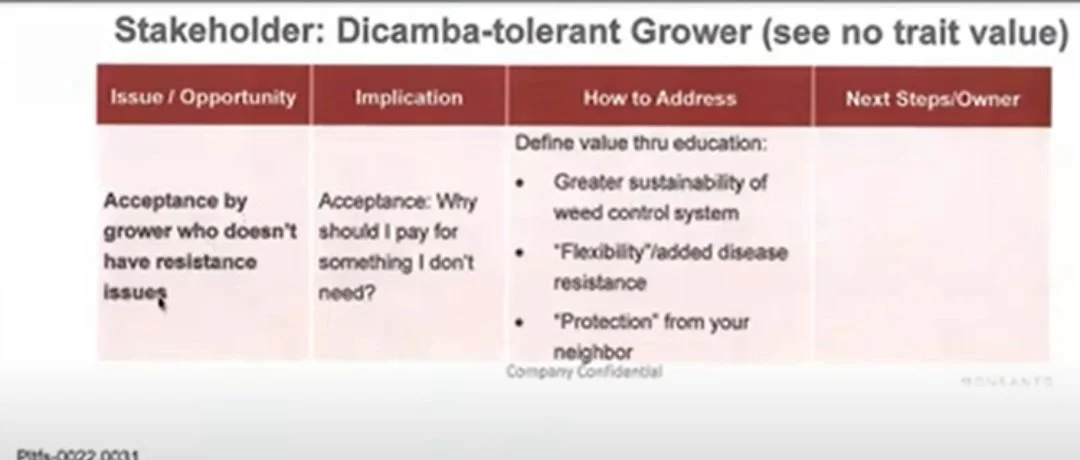
“Protection from your neighbor”. This document, which was not made public until the trial, was part of a series of internal communications showing that Monsanto was well aware of the risks associated with Dicamba drift and to use it as a marketing point to other farmers. Exhibit PLTF-521, an email between company executives, demonstrated that Monsanto had knowledge that Dicamba would, in fact, drift and cause significant problems for farmers across the country. The email also revealed that Monsanto anticipated the EPA’s warning labels—designed to protect against Dicamba’s harmful effects—would be ignored, and that Dicamba would be used despite not having an approved formulation by the FBA. Dicamba is still wreaking havoc on farm culture today. Both organic and conventional, across the country.
The widespread drift of Dicamba caused extensive damage to thousands of acres of crops, leading to a growing number of farmers filing claims against Monsanto (now part of Bayer) and BASF. Over 100 farmers’ claims were combined into multidistrict litigation (MDL 2820) in the U.S. District Court for the Eastern District of Missouri, located in Cape Girardeau. Among the plaintiffs, Bader Farms, a peach farm, reported a staggering $1.5 million loss in gross sales and the destruction of 30,000 peach trees due to the herbicide drift.
The trial was fast tracked and began January 27, 2020, and just a few weeks later on February 14 2020 he U.S. District Court found Bayer and BASF liable for the damage caused to the 30,000+ peach trees at Bader Farms. The court awarded Bader Farms $15 million in damages, while Bayer and BASF were ordered to pay an additional $250 million in punitive damages for their role in the herbicide disaster.
The ruling set a significant legal precedent, and the number of farmers seeking legal representation to file lawsuits against Monsanto, Bayer, and BASF has only surged in the aftermath. The case underscores the ongoing consequences of Monsanto’s actions and the serious implications of their products on farmers, the environment, and public health.
FG Ferber: Key architect of Monsanto’s chemical empire
During WWII Germany was using a chemical in their nerve agents called Zyklon B gas, the company supplying this chemical was called IG Farben. IG Farben, formed in 1925 was a massive entity, controlling numerous chemical companies, including Bayer. After the war IG Farben was dismantled and Bayer and the other companies that had been part of the conglomerate became independent again.
One of the most significant figures associated with IG Farben during World War II was Otto Ambros, a chemist who played a prominent role in developing synthetic chemicals for the German war effort, including the production of nerve agents. After the war, Ambros was arrested due to the war crimes committed by IG Farben and was tried at the Nuremburg trials. He was convicted of crimes against humanity and was sentenced to 8 years in prison, however he was released after 3. After his release, Ambros went on to work for Bayer.
This pattern was not unique to Bayer. Numerous former Nazi scientists found work with pharmaceutical and chemical companies in the post-war era, contributing to the growth of industries that would later have profound impacts on public health and the environment. These recruits often brought with them expertise in chemical production, but their previous ties to war crimes and unethical experimentation raised serious ethical questions.
In the aftermath of World War II, the chemical industry, particularly companies like Bayer and Monsanto, saw a troubling continuity. Not only did former Nazi scientists, such as Otto Ambros, who had been involved in the development of wartime chemicals, find new roles in these companies, but the chemicals originally produced for warfare also found their way into civilian markets. Many of these companies pivoted from manufacturing deadly agents like Zyklon B and Agent Orange to using their expertise in chemical production to develop herbicides, pesticides, and genetically modified crops.
Before these chemicals were ever used in chemical warfare, they were classified as herbicides, pesticides, and insecticides; but it was also known that they caused great harm to humans. Shortly after Zyklon B was released for use in the Holocaust, Monsanto introduced Agent Orange, a herbicide that would later cause immense human suffering in the Vietnam War. These chemicals, initially created for military purposes, were later repurposed in agriculture, where they were marketed as solutions to pest control and crop management.
But the chemical technologies that had been born of wartime devastation were now being applied to food production, with little regard for their potential harm. By the time these chemicals entered the agricultural market, their toxicity was already well-documented—but the drive for profit and agricultural efficiency overshadowed the mounting environmental and health risks.
The disturbing legacy of this history raises critical ethical questions about the role of corporations in shaping our world, the continued use of harmful chemicals, and the unchecked influence of historical figures who shaped these industries. In the end, the transition from war chemicals to food production illustrates a chilling trajectory: former agents of destruction became key ingredients in the corporate drive for control over the food and agricultural systems that sustain us.
Consider this…
How much trust can we place in modern studies funded by the very companies that stand to profit from the products they claim are “safe”?
Are we repeating the same mistakes today with other chemicals, continuing to prioritize corporate profit over the health and safety of our children, our families, and the environment?
When we see regulators dismissing or downplaying harmful effects, as was done with Agent Orange and Dicamba, what makes us think the same is not happening now?
Should we question whether we are being fed a narrative of safety, while history reveals a pattern of obfuscation and negligence?
The Present Day: Corporate Influence on Our Food System
Monsanto controls about 80% of our food supply in the United States due to their patented seeds.
There are 10 companies that own the entirety of our food system.
Nestle- One of the largest food and beverage companies in the world, with products ranging from bottled water to baby food, coffee, and more.
PepsiCo- A massive player in snacks, beverages, and packaged foods (including brands like Lay’s, Mountain Dew, and Quaker).
Coca-Cola - Primarily known for its beverages, but also a major player in the global food supply.
Unilever– A major multinational in the food and beverage, health, and personal care sectors, with products like Hellmann's, Ben & Jerry's, and Lipton.
Tyson Foods– One of the largest meat producers in the world, including chicken, beef, and pork.
JBS– A Brazilian multinational that is one of the largest meat processing companies in the world.
Monsanto (now part of Bayer)– As discussed earlier, they control a huge portion of the global seed and agricultural chemical markets, including GMOs and herbicides.
ADM (Archer Daniels Midland)– A major global player in the agricultural supply chain, involved in the processing of grains and oilseeds, as well as ingredients for food products.
General Mills– Known for packaged foods and cereal brands like Cheerios, Betty Crocker, and Haagen-Dazs.
Kraft Heinz– The result of the merger between Kraft and Heinz, with popular brands like Kraft, Heinz, Oscar Mayer, and Planters.
A 2012 study conducted by researchers in France, led by Professor Gilles-Éric Séralini, which examined the effects of genetically modified (GMO) corn, specifically Monsanto’s Roundup Ready corn, on rats. The study found that rats fed a diet containing the genetically modified corn developed tumors and other health problems, suggesting potential health risks associated with consuming GMOs. Monsanto, along with other critics, argued that the study was flawed and methodologically unsound, leading to the paper being retracted by the Food and Chemical Toxicology journal in 2013. Monsanto, as well as other critics of the study, pressured the journal into retracting it, which led to accusations of corporate influence over scientific research. In 2014, the data from Séralini’s team was republished in another peer-reviewed scientific journal, Environmental Sciences Europe, with the original conclusions largely intact.
Bayer has been lobbying for legal immunity, trying to push for legislative reforms that would protect the company from being sued over its products, especially glyphosate. In addition to the legal battles, there have been regulatory challenges and public backlash about the safety of glyphosate-based herbicides. Many critics argue that such a move would prioritize corporate interests over public health and safety, especially considering the growing body of evidence about the risks of glyphosate. As of 2023 Bayer has spent of $16 billion on legal settlements and related costs connected to the litigation over glyphosate. This includes settlements with tens of thousands of plaintiffs who claimed that exposure to glyphosate caused non-Hodgkin's lymphoma and other cancers. In addition to settlements, Bayer has incurred substantial legal fees and other expenses defending against these lawsuits. Bayer continues to face legal challenges with ongoing lawsuits.
Consider this…
When large corporations spend billions on legal battles and settlements, rather than addressing the underlying health concerns of their products, does that tell us something about their priorities?
Can we really trust that "independent" studies on the safety of GMOs, herbicides, and pesticides are free from corporate influence, especially when companies like Monsanto have a history of suppressing research that questions their products?
If a company can manipulate science and pay millions to avoid accountability for harmful products, what does this say about the fairness and effectiveness of our legal and regulatory systems?
What would happen to our food system if corporate control over agriculture was reduced, and smaller, independent, and more sustainable farming practices were allowed to flourish?
What would happen if companies like Bayer (formerly Monsanto) were no longer legally accountable for the harm caused by their chemicals, such as glyphosate and PCBs? Could it set a dangerous precedent for other corporations, allowing them to prioritize profit over public health and environmental safety without fear of repercussions?
Is it ethical for pharmaceutical and agricultural companies to profit from products that have potentially devastating long-term health and environmental effects, especially when the public has little access to transparent data about these products?